
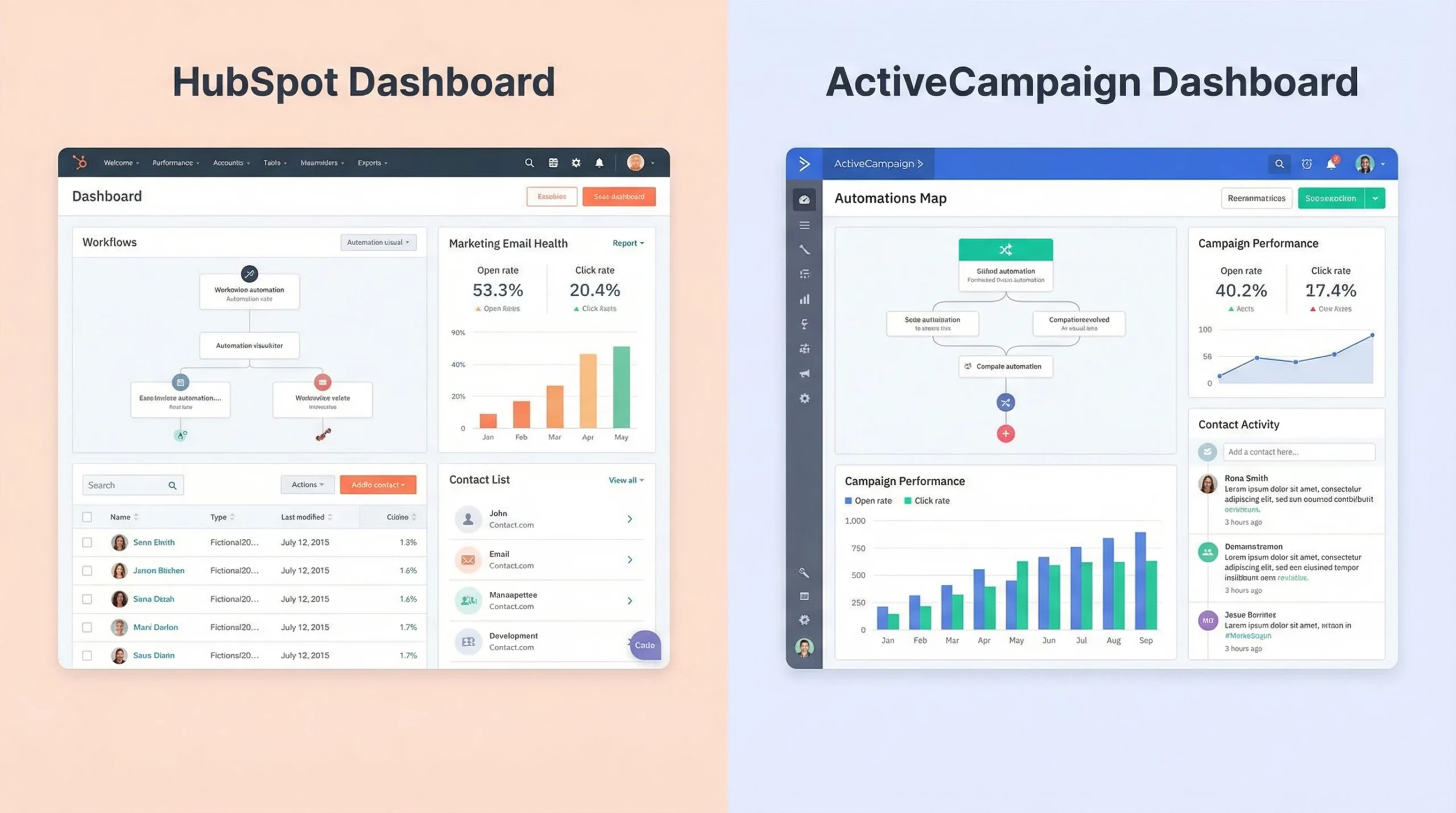
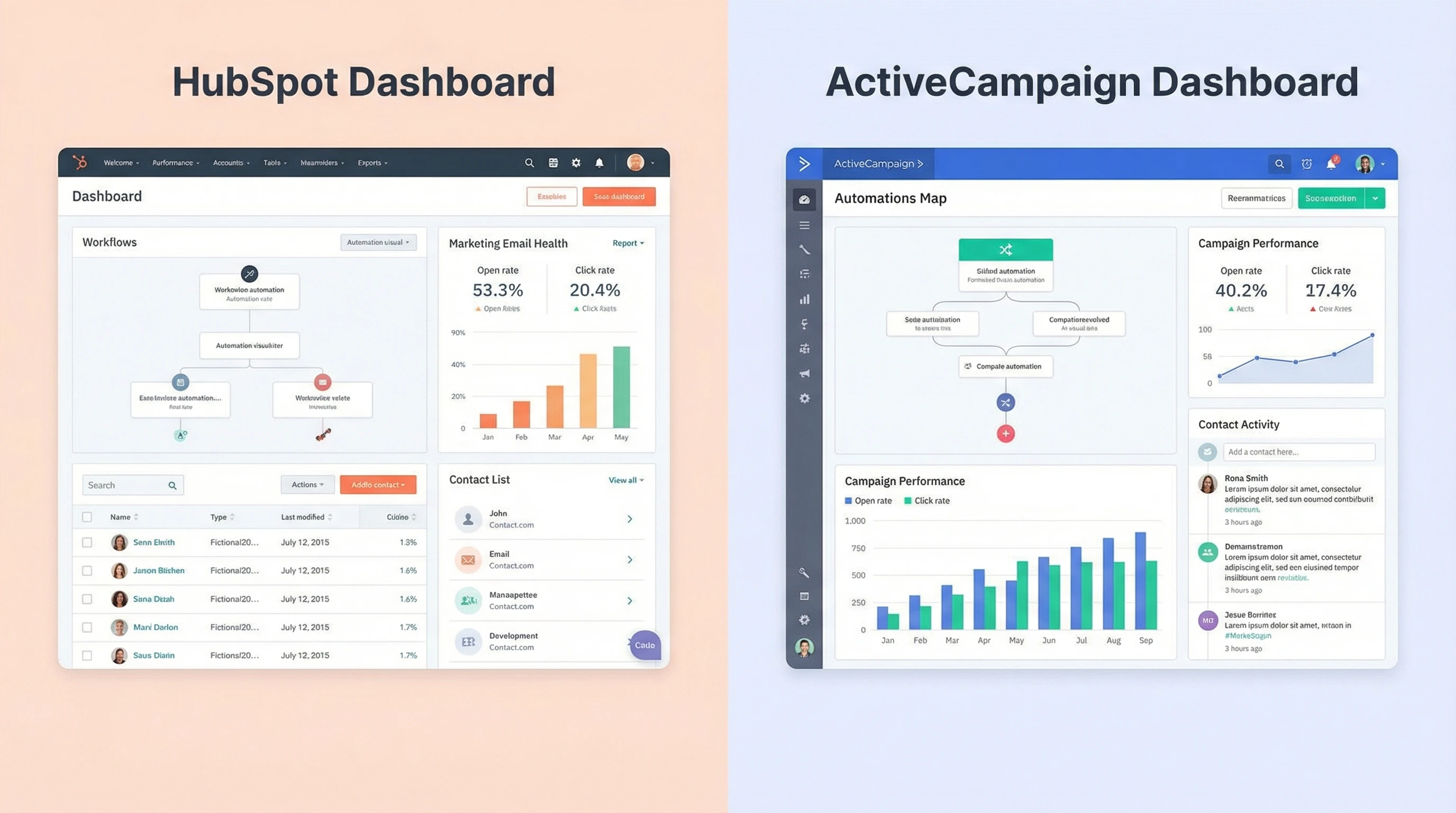
If you run a small business and you’ve shopped around for marketing tools, you probably noticed something right away: HubSpot grabs your attention with a low Starter plan, but any real automation, reporting, or sales upgrades mean jumping to a Pro plan that starts at $800 per month. That doesn’t even include the $3,000 mandatory onboarding fee. ActiveCampaign, on the other hand, gives you advanced automation and marketing power for around $149 per month for 10,000 contacts. I’ve worked with teams who used both tools and seen exactly how this price difference impacts your bottom line.
I’ve also seen plenty of business owners wonder if paying more for HubSpot is actually worth it. Here’s the direct answer: in most cases, ActiveCampaign can give you most of the same tools plus more flexibility at a much lighter monthly bill. Below, I’ll explain how both platforms compare based on costs, marketing power, deliverability, advanced features, and when it actually makes sense to spend on HubSpot.
Quick Comparison: HubSpot vs ActiveCampaign
| ActiveCampaign | HubSpot | |
|---|---|---|
| Price (10,000 Contacts) | $149/mo | $800+/mo |
| Email Deliverability | 93.4% | 79.8% |
| Onboarding | Free | $3,000+ Mandatory |
Overview: Who Are These Tools For?
What is HubSpot Marketing Hub?
HubSpot Marketing Hub is a big allinone marketing platform that covers email, forms, automation, landing pages, ads, live chat, and more. It’s built around the idea that you should use all the pieces (including their CRM, sales, customer service, and CMS modules) as one tight system. It’s a favorite in larger organizations that need everything in one place and have teams to run complex campaigns.
What is ActiveCampaign?
ActiveCampaign is a dedicated automation and email marketing platform that doubles as a simple sales CRM. It’s focused on making sales and marketing easier for fastmoving businesses that need powerful automation, great email deliverability, and easytounderstand pricing. I’ve found it to be a flexible tool that small and medium businesses can set up with less hassle.
Who Should Use Each Tool?
- HubSpot is best for companies that want to manage all marketing, sales, and service in one highend ecosystem, and don’t mind high, changeable pricing.
- ActiveCampaign is ideal for businesses that care about reliable automation, great email deliverability, and keeping costs predictable.
ActiveCampaign and HubSpot: Pros & Cons
ActiveCampaign Pros
- Flat, predictable pricing as you grow
- Strong automations (500+ recipes to choose from)
- Superb deliverability, helping your emails avoid spam
- Easy CRM features for small sales teams
- No onboarding fee
ActiveCampaign Cons
- Reporting is basic compared to HubSpot’s analytics
- No builtin CMS or website tools
HubSpot Pros
- Industryleading analytics, especially for Enterprise
- Allinone ecosystem (Sales, Service, CMS, Marketing)
- Strong integration with dozens of apps and services
- Great for B2B companies with big marketing teams
HubSpot Cons
- High price jumps as you gain more contacts
- Mandatory onboarding fee (no way around it)
- Contactbased pricing can blow up your monthly costs
- Email deliverability is lower than ActiveCampaign
The $800 Marketing Decision: Value vs. Luxury
I’ve had these conversations over and over with business owners. If you’re on a budget, here’s what usually happens: you start on HubSpot’s $20/month Starter, but you immediately run into limits, like not being able to automate beyond the basics or lacking reporting. So you move up to the Pro plan, and your bill rockets to $800+/mo, not counting onboarding. For most small businesses, that’s a real hit to your cash flow.
With ActiveCampaign, the fullfeatured plan for up to 10,000 contacts sits at $149/month. You don’t get hit with “contact tiers” that move you up to the next pricing group every time you grow. That alone can save you $8,000 or more per year versus HubSpot.
To put this into context, imagine allocating that extra $8,000 savings into advertising, additional team members, or customer acquisition projects. The impact on your business growth can be significant, letting you expand faster and adapt to new opportunities as they arise.
Round 1: The “Hidden Costs” of HubSpot
There’s something every small business owner should look out for in HubSpot pricing: the “Marketing Contacts” model. HubSpot doesn’t charge for every contact, only “marketing contacts”; but almost every important report and automation in your account will push contacts into this category. If your list grows, so does your monthly bill.
Most people find that their universe of “marketing contacts” lets HubSpot bump them up into $1,600/month territory as they expand. For small and mediumsized businesses, that makes budget planning much harder. In comparison, ActiveCampaign gives you a clear, predictable rate tied to your total number of contacts, with no billing tricks, no onboarding fee, and no forced bumps for features you didn’t ask for.
It’s also worth mentioning that HubSpot’s contract terms can lock you in for a year or more at a steep rate. If you’re testing out new marketing methods, being tied down to a high monthly minimum can stifle flexibility. ActiveCampaign is monthtomonth and lets you adjust as you grow, minimizing risk as your business needs change throughout the year.
Round 2: Automation Power & Deliverability (ActiveCampaign Wins)
This part gets real for email marketers. Email deliverability is the rate at which your messages actually make it into inboxes (instead of spam or promotions tabs).
- ActiveCampaign: 93.4% deliverability
- HubSpot: 79.8% deliverability
That means nearly one out of every five HubSpot emails misses the mark, while ActiveCampaign delivers to far more real inboxes. For any business that counts on email to drive sales, that’s a huge deal.
The automation builder in ActiveCampaign is also easier for most teams to use. With over 500 prebuilt automations (“recipes”) that you can plug in, and a visual, drag and drop setup, creating audience rides becomes much smoother. I’ve seen sales teams use it to trigger followup sequences, track lead scores, and even autoroute new deals into pipelines—all without a developer.
HubSpot features powerful automation as well, but you only unlock it at highertier (Pro or Enterprise) plans. That blocks many smaller teams from the kinds of workflows that really move the needle.
Email Templates, Segmentation, and Personalization
Both platforms offer good support for dynamic email templates, audience segmentation, and personalization tags. The difference is that ActiveCampaign supports deep segmentation, down to how users interact with your emails and website, while HubSpot encourages you to use the rest of their system for better info. For smaller operations, I find ActiveCampaign offers more speed and flexibility in getting highperforming campaigns out the door.
ActiveCampaign’s intuitive draganddrop builder also makes it easy for nontech users to build visually appealing emails, test different versions, and reach specific audience segments based on behavior and engagement. You can quickly adapt to changes in your customer base, giving each group what they want most.
Round 3: Where HubSpot Actually Wins
If you’re running an enterprise business or a growing team that needs everything—marketing, sales, support, CMS, and advanced reporting—HubSpot does deliver. Its analytics make it much easier to view marketing and sales performance across every channel. For organizations with big reporting needs, attribution modeling, revenue tracking, and multitouch analytics, HubSpot can simplify complex reporting that would take hours with separate tools.
HubSpot also wins when you want every tool under one login. With CMS Hub, Sales Hub, and Service Hub, you get an entire suite that connects chat, landing pages, email, and support records. Many teams like the peace of mind that comes with a single system, even if the price is high. In my experience, this makes sense for companies with large marketing budgets and a lot of inhouse staff to manage multiple channels.
You also get a highly customizable dashboard through HubSpot, allowing various departments to access real time performance data. This centralized access can be a huge advantage for teams coordinating large projects, running multichannel initiatives, or working with outside partners—it provides an instant view of all your activities.
The “Insider Secret”: The Hybrid Model
If you’re caught in the middle, needing some of HubSpot’s strengths but wanting to avoid eye watering bills, here’s an approach I recommend. Use HubSpot’s free CRM for your sales team. It’s genuinely great at tracking deals, logging calls, and storing contact info. Then, connect ActiveCampaign for your email marketing and automation. The integration is smooth, and you can sync contacts between the systems. This setup gives you most of the benefits at a fraction of the cost, and helps you sidestep the steep pricing jumps linked to HubSpot’s marketing contacts. In real numbers, it’s saved my clients around $10,000 each year.
The hybrid model is straightforward to implement and delivers practical results. You get flexibility, topnotch deliverability, and reliable tracking, without locking your business into unnecessary expenses. It’s a way to get big business benefits on a small business budget.
Features FaceOff: Key Aspects by Category
- Automations: ActiveCampaign wins for flexibility and plugandplay recipes. HubSpot is powerful but you pay a lot more to unlock advanced features.
- Email Deliverability: Higher on ActiveCampaign, which can translate to more leads and sales over time.
- Reporting: HubSpot takes the lead with deep analytics, especially for bigger teams who need to report on every channel in detail.
- CRM & Ecosystem: HubSpot’s integrated ecosystem is a good fit for bigger companies that want to connect every workflow from sales to support. For most small businesses, ActiveCampaign’s builtin CRM covers the basics.
- Pricing: ActiveCampaign’s flat rate and no onboarding fee make it friendlier to growing businesses.
In addition, ActiveCampaign stands out for its robust app marketplace, letting you link up eCommerce, support, and webinar tools like Shopify, Zendesk, and Zoom. This integration flexibility means you can tailor your marketing stack to your needs, without being forced to buy modules you don’t use. HubSpot’s ecosystem is broader, but with a much steeper price for access to the full suite of capabilities.
User Experience & Reviews
- ActiveCampaign: Praised for its easy setup, responsive support team, and straightforward automation builder. Most users stick with it for the value and delivery results.
- HubSpot: Widely liked for enterprisegrade tools and strong customer success programs. Many users, especially smaller teams, get frustrated by price jumps and paywalls for core features.
When talking with other marketing consultants, I often hear the same thing: HubSpot looks beautiful, but the costs are daunting for anything but big, resourceheavy teams. ActiveCampaign delivers where it counts for small and medium businesses. It’s known for reliable sends, flexible automation, and pricing that doesn’t give you sticker shock as you grow.
Many small business owners also appreciate ActiveCampaign’s ongoing updates to its platform, which include performance improvements and new integration options. HubSpot offers impressive depth, yet the hidden costs—or mandatory onboarding fees—still bring hesitation to smaller organizations.
The Final Verdict: Who Gets My CFO Vote?
- Winner for Value and ROI: ActiveCampaign wins for businesses that want strong sales and marketing automation at a fair price. It gives you more power and reach without draining your budget. The higher email delivery rate can bring in thousands of dollars of extra revenue yearly, just by avoiding the spam folder.
- Winner for Enterprise Teams: HubSpot is for companies that need unified reporting across marketing, sales, service, and content. If you have an unlimited budget and need deep, companywide insights, it’s worth consideration.
If you’re a small business owner working to get the most out of every dollar, ActiveCampaign is the top pick. For tight budgets, or if you want to keep marketing spend predictable, skip the HubSpot upgrade and focus on a system that pays you back faster. If you do need fullscale reporting and every module under a single login, HubSpot has your back. Just prepare for the bill.
Still need to make the call? Here’s the line I use with clients: Don’t pay for marketing luxury if you can get more value for less. Smart spending leaves room for actual growth. Choosing a system that matches your goals and lets your business flex when you need to is always the smarter investment.
Ways to Assess Your Marketing Software Needs:
- If your marketing is growing month by month and your list is getting bigger at a steady pace, look for tools with predictable pricing that don’t penalize you for new contacts.
- If rich, multiapp integration and universal reporting are your top priorities—and cost isn’t—the convenience of HubSpot’s allinone platform may justify the spend.
- Test each platform’s free trial or demo before locking in. Sometimes, you’ll stumble upon features that suit your workflow better than expected.
Wrapping up, picking between HubSpot and ActiveCampaign will shape your marketing workflow and your monthly budget. Use the info above to match your real business needs, and don’t be afraid to build a custom stack or try the hybrid approach if that brings you the best mix of value and power.
Thanks for the comparison — as someone new to CRM and automation tools, could you share a simple example of how a basic workflow (like capturing a lead and sending follow-up emails) would look different in HubSpot versus ActiveCampaign? I’m especially curious about which platform feels more intuitive for beginners during setup and daily use.
Hi HalfAmazing! That is a brilliant way to frame it. Let’s look at a simple Lead Capture workflow:
In HubSpot: The experience is ‘all-in-one.’ You’ll likely build your form, your landing page, and your follow-up email all inside the same HubSpot interface. Because it’s a ‘Unified CRM,’ you can see exactly which page they visited before they signed up. It feels very smooth, but it can sometimes feel ‘heavy’ because there are so many tools around you that you might not need yet.
In ActiveCampaign: The experience is ‘Automation-First.’ You might use a different tool for your website (like WordPress), but ActiveCampaign acts as the ‘brain.’ Its Visual Automation Builder is widely considered the most intuitive for beginners because it looks like a clear flowchart. You can see exactly how a lead ‘travels’ from signing up to receiving their third email.
The Verdict: If you want one big toolbox where everything is connected by default, HubSpot is incredibly intuitive. If you want a specialized ‘brain’ for your emails that is easy to map out visually, ActiveCampaign is hard to beat.
Great breakdown of HubSpot vs ActiveCampaign! I’ve worked with small business teams and can confirm that the difference in pricing and email deliverability is huge. ActiveCampaign’s 93%+ deliverability and flat pricing make it a practical choice for growing businesses, especially when you don’t want surprise cost jumps.
I also like the hybrid approach you mentioned, using HubSpot CRM for sales tracking while running marketing campaigns through ActiveCampaign seems like a smart way to get the best of both worlds without overpaying.
For those debating between the two, I’d say: ask yourself if you really need every module HubSpot offers, or if predictable pricing and strong automation will get you further faster.